Monday, September 23, 2013

On the making of better SCAdians...

I'm continuing with posting some of my thoughts about the SCA and how I would like to see it improve. Today, I'd like to concentrate on my thoughts about newcomers.

I love newcomers. To them all of the grandeur, pomp and pageantry of the SCA is a wonder. I love watching how they wince when they watch a strong blow landed in a heavy combat tourney, how they lean forward listening to songs at a bardic circle, how they just see with wonder the things to which we have become accustomed.

How do we help them to keep that wonder and become members of our community rather than just visitors? What takes a spectator and makes them yearn to be a participant? We must include new people and train them to be better SCAdians. However, we have to be better SCAdians as we work to set that example.

It takes a little time. It means a little forethought. It requires you to think about more than just yourself and your friends. Sure, it's easy to get caught up in what you are doing but think of it this way- that new person might be the one helping you mop a hall in ten years.

Fact: People like to feel welcome.
It is hella uncomfortable to stand around in a room or campsite full of people who all know each other and are chatting amiably when you don't know a soul. Make a small effort to be welcoming and you might find a new friend or just help a new SCAdian get started a little easier. Invite new people to step deeper into an event, a class, a project and help them become welcome participants.

  • We can welcome new people by smiling and saying good day each time we see someone who we do not recognize. Positive body language and polite conversation are a nice place to start.
  • We can introduce ourselves to people we don't know. "Hi, I'm sorry, have we met? I'm so and so. Are you new to the area?"
  • If you are sitting at a bardic or in a class and someone wanders up looking interested, take a moment and invite them to come closer and join the group. Let them know what is going on and let them know they can ask questions.

Fact: People like to feel needed and useful.
Standing around with empty hands when everyone else has something to do is uncomfortable. No event in the history of the SCA has ever gone off without a bunch of help being needed. Try to look out for new people and invite them to pitch in.

  • Introduce yourself to people who look lost or alone when you are working on a project. Invite them to help you but let them know that they do not have to help. "Hi there, if you have a few minutes would you mind lending us a hand setting up these chairs?"
  • If you are working on a project and notice someone watching ask them if they would like to learn more about it. "Hi, I'm processing reservations for the event. Would you like to learn more about how we do this?" "I'm chopping vegetables for dinner tonight. Want to keep us company while we work?" 
  • Say thank you every time someone helps you. If you have just met them or if you have known them for decades, it does not matter. They helped you. Offer your thanks often and loudly.

Fact: People like to feel attractive.
Just once, take a moment to watch how a person changes at a day event when they wear their mundane clothing into a changing space and come out wrapped in a different century. Those who dress up stand a little straighter and smile a little easier. When people feel like they look good, they feel instantly better about themselves. Don't donate your hideous old kitchen tunic to Gold Key. Don't put your newcomer in rags.

  • Make an effort to help new people find loaner clothing that will fit them properly, be comfortable and will look nice. No, they don't need to be fully kitted in Elizabethan, but help them look respectable.
  • Make an item and donate it to Gold Key. A simple tunic dress, a fresh and clean pair of pants and tunic, accessories like simple belts. 
  • Take a moment of your time and tell people when they look good. New or old to the SCA, a genuine compliment feels good. 
  • Don't send out a new person dressed in something you would be embarrassed to wear. Ever.
  • If a new person admires your garb, help them find the knowledge on how to purchase it or how to get started with making it. Never tell someone that your garb would be too difficult or complex for them to make. It's rude and you have no idea what they are capable of. Be a good teacher, a good SCAdian and a good person. 

Fact: People like to feel knowledgeable.
When new people ghost around the edges of classes, tourney fields or even groups of people, they are interested. Something drew them in and caught their attention. Take some time with new people and help them find out how to learn more

  • Ask people what interests them and then suggest people on site or upcoming classes that might be able to help them gain knowledge.
  • Suggest some good books or websites on the topic. Ask for their email address and share your knowledge with them in a way that is useful and not an on-the-spot info dump.
  • No one gets it right the first time or every time. If someone makes a mistake, uses the wrong title of address or uses the wrong term for something accidentally, be polite and correct them with a smile. Use gentle language like you would want from someone who was correcting you. 

Fact: People like to feel appreciated. 
Doing a good job or working hard and then not being acknowledged is a soul-sucking experience.

  • Say thank you. A lot. Whenever someone helps you, say thanks. Every time. It's not overkill.
  • Be free with tokens of thanks. Pack a few blank note cards that can be turned into on-the-spot thank you notes. Have a few spare items of largess that you can hand to someone when they do something cool or helpful. Exhibiting this behavior of recognition helps to teach our new people how they can thank people in the future. 
  • Give honest and genuine compliments. Tell people when they look good or that you appreciate their effort with something they have done. Thank people for serving. 
  • Compliment even small acts of chivalry. A new person offering to help carry a chair should be made to feel welcome and then thanked for their effort. a gentleman pausing so that a lady can pass. Someone holding a door. These are the ideals we want in our society. Start by doing them. Finish with acknowledging them in others. In time, it really will catch on.

Fact: People like to try stuff out.
One of the recent inspirations that struck me was from one of my own associates: My apprentice HL Finnguala inghen Alister was making a piece of stick weaving and another friend looked on with interest. "Do you want to learn how to make this?" Finnguala asked. The other lady quickly said yes. Finnguala whipped a stick weaving starter kit out of a bag and put it in the lady's hands. "Let's get you started then." I was floored: what a great way to get someone started with an art? It made me realize that I need to up my game. A scribal art starter kit might be a little harder, but maybe I just need to think a lit farther out of the box.

What have I left out? How can I be a better SCAdian by helping others get involved in this club?

Wednesday, September 11, 2013

About this Game I Play

I have made amazing friends.
I am going to take a few moments to step away from my art and talk about the club in which I participate: the Society for Creative Anachronism. On many weekends a year, I join hundreds of friends at campsites around Florida. I put on medieval clothing and step into another persona. I pick up a quill and a brush and become a respected artisan among people who do hundreds of crafts of the middle ages. I walk past Knights who smile and nod their head to me. I exchange gentle banter with bards and gorgeous royal ladies. I use my hands to help others shape a modern place and time into a shadow of the middle ages and then I step inside for a weekend at a time.

Who gets to do that? Me! Isn't that freaking cool? I think so!

The club has its ups and downs for everyone. I've been an active participant for around 15 years. I've been a Laurel for nearly 10 of those. I have had good and bad times, but I have learned some amazing things and some valuable lessons. I have met incredible people. I have loved. I have lost. I am still here. Why do I do it? Well, I believe in the life lessons this hobby can provide and feel it is a worthwhile way to spend my time. I surround myself with remarkable people and we do remarkable things. So here are a few of my ruminations about this club to which I belong.

I get to wear fun dresses.

What I love about the SCA

There are lots of reasons I love this hobby, but the foremost is the people who play along side me. Their constant and surprising passions for long dead crafts, serving others and the joy of physical combat undertaken for sport.

Some people think this club is odd or quirky. Sure, maybe. But sitting on a couch watching sports has never appealed to me. I've always prefer to participate rather than spectate. I suck at sitting by and watching others do anything while I am still. I like too many things, learning and reading too much to just pick one hobby. So I found a hobby that keeps me busy, helps me meet interesting people and where I can practice two dozen arts in a day and think of it as a normal happenstance.

Snapshots


  • The look in the eye of a fighter right after they reach a resurrection point and turn around to head back into a large battle. Determined. Gritty. Ready. Ecstatic. Giddy.
  • Artgasm: the rapturous look that comes over artists as they make a leap of understanding in their craft or while they are explaining it to someone who seems to be interested.
  • The crinkle at the corner of the eye of someone who smiles as they are being thanked for their service: the bashful grin, the slight glow, the spring in their step as they move away and continue working. 
  • The straight and upright stance of a newcomer as they don their first beautiful garment. Either made by their own hands or loaned from a friend, there is something special about that first time that you realize that you look medieval and that you look good!

What I don't love about the SCA

We put ourselves and our hobby down by belittling it. We fall into politics. We allow ourselves to speak out negatively about people rather than trying to reach out a hand and help. Every social club has this same problem that is bred by its own membership. But we can be so much more.

Snapshots:

  • Telling someone that you wear funny clothes on weekends: They aren't funny, they are awesome. Pieces of cloth that have been worked into art and that are imbued with the story of a time, a place and the people who wore them in history.
  • Talking down your skill as an archer because you do it in a medieval club. You are a goddamned archer. Do you know how cool that is? You wield a weapon that helped to decide battles and changed the face of history and you do it competently. Hell yeah, that is awesome.
  • Worked with two friends and made a runestone.
    Who gets to do that? Us!
  • Making light of the SCA as a club for drinking or free love. Sure, some people have a beer (or several). Some people at an event might be totally sauced and stupid with drink, but they are at an event that happened entirely because of volunteers. People who are not being paid anything have put together a medieval event at a church or a campsite or park. At that event there are classes, battles, courts, feasts, royalty, chivalry. That is rad. Some people drinking or hooking up does not take away from the insane amount of effort and creativity that goes into making an event go off without an obvious hitch. Be proud of what we accomplish on a regular basis. We make the middle ages come alive and breath life back into the crafts, arts and combat of the middle ages. What isn't amazing about that?

What I'd like to change about the SCA

I guess the things that I would like to change about the SCA fall into three major categories: how we treat and empower young people, recording our history and training our volunteers and, lastly, dispelling the aura of chivalry that keeps us from calling people out when they make trouble.

Youth

Young people are the future of our organization. Every time we invest in them and empower them we help them to learn a bit more about who they want to or can be. We need to show them, by example and through mentorship, how we want this club to carry forward, evolve and improve for future generations. In the middle ages, many of our teens would have been considered to have reached an age of majority yet we treat them like children and lump them in with much younger groups. I strongly feel that we work too hard to keep teens as children well beyond when we should.

Ask a teen what they want to learn in the SCA and their answers will shock you. Blacksmithing, feast preparation, medieval cooking, how to run an event, combat, arts. The same answers a college student new to the SCA would give. Let's start working to provide opportunities for our young people who are asking for more. Can a 13 year old be the head server at a feast? Yep. Can a 16 year old become a competent scribe? Oh yeah. Can an 18 year old win crown tourney? Yes, they can. They are people, just shorter (however, not shorter than me in most cases) and without as much world experience. These are the officers who will take over for us when we are exhausted. These are the people who will run events when we run out of energy or care. Treat them like people. Find out what they want to achieve and help them find a way to make it happen.

I make art in public.

Memory and Training

We do a shockingly bad job of recording our own history in the SCA. Who won a tourney at this event 4 years ago? Uhhhhh. Who got the art/sci awards a decade ago? Ummmm. Where is the information that I need to do this job I volunteered for? Yeah....

We need to record our own history and then publish and share that history in ways that are both relevant and accessible. We need to train our volunteers how to hold offices and have central locations to retain handbooks, forms, waivers and documents that can help those officers. No one should have to reinvent the wheel every two years. We should pass information on also to our royalty so they know, without surprise, what will be expected of them and what their expectations should be for those volunteering in offices that will work with and for them.

Take an office. Learn it inside and out. Find the problems. Try to fix them. Record your process and reports. Train your successor. Pass on your knowledge and information. Leave the office better than you found it.

Troublemakers

Every group and club has them: people that just cause trouble. In the SCA, so often we step behind chivalry and politeness that we don't actually tell troublemakers that they are making trouble. They may not even know how they are perceived by others. This isn't nice on our part and we aren't being gallant. We are letting problems get bigger and not taking care of issues when a few words might fix a wrong. These troublesome people and situations spiral out of control and people quit the SCA in a snit or find another hobby with less perceived drama.

How do we fix this? Well, it sucks, but we have to talk to people and tell them the truth. We can be honest and yet still be polite but it is a scary thing. Will someone think you are a horrible and unkind person when you talk to someone about perceived bad behavior? Yeah, probably. Might it still be helpful? Maybe, yes. Might sometimes you be the one with the hangup or a misunderstanding and find yourself needing to make an apology? Yep, that might happen. But we can at least try to make the group better and be honest with people about how their words and deeds are perceived by others.

  • The person who gossips with you at every opportunity and tells you juicy tidbits about others very likely has juicy tidbits about you that they share with the next person who walks or phones up. 
  • The horrible mean person at registration might just be way out of their depth and feel thrown to the wolves with no idea how their actions are being perceived. Why not offer help and then quietly pull them aside when things calm down?
  • That awful peer that said something nasty is still a person and is likely having a crappy day. Have a quiet chat and remind them that their words are powerful and can hurt people in terrible ways.
  • Sometimes we gain a reputation of which we have no idea. People think we are grasping, unkind, ladder climbing, hob nobbing, brown nosing, rude to newcomers, or something else. Let a friend know how they are perceived by others. Tell them as gently as you can and somewhere without an audience. They may have no idea of their reputation and with knowledge and some good choices they can turn that perception around. 

I learned that I can write in knotwork. 

What in the SCA inspires me to keep playing

Quite a few things:

  • My associates, students, friends and their love of their arts and their service. The gleam in their eyes as they dream up a new project and that sly smile that they wear when they know they have something really, really cool. I draw my inspiration from them. I remember what it was like to be un-jaded and have a limitless view of the world we are trying to build.
  • When someone says thank you for something I have done or made.
  • When I watch people enjoy something I have made.
  • New people and their wonder.
  • Those few undefinable 'perfect reenactor moments' where we get a chill as we step into a moment, a scene that seems so right for the time period we are playing that it shocks even us. Sweet God, I think this is what the 14th century actually looked and tasted and sounded and felt like! Those moments seep into your bones and help propel you forward later when you are tired. They live in your dreams and curl like a mist at the edges of your vision, coaxing you to try a little harder and believe a little more. 
  • Artgasms. Cannot even make words that explain this feeling. Holy crap, I just painted a 15th century illumination and it looks pretty! I made someone cry by handing them something inspired by what they love most from the middle ages. Priceless.

How to make the SCA better, from my point of view


  • Show up. 
  • Try to see the good in what people are doing rather than searching for the possible bad.
  • Volunteer often.
  • Meet new people.
  • Be willing to let your opinions of people change as they evolve.
  • Don't perpetuate gossip.
  • Make something beautiful.
  • Keep old friends.
  • Aim to inspire others in your dress, your words, your manners and your deeds.
  • Lead by example and from the front. 
  • Stay willing to get in the trenches. Ladders need climbing, toilets need plunging, stoves need fixing, events need to be run, water needs to be toted. Be willing to be a good participant. We need every one of us.
  • Tell someone they are an inspiration.
  • Thank everyone who helps. Often. Loudly.
  • Speak your problems quietly, with logic and be at least business polite at all times.
  • Invite friends back to the SCA when they are dispirited by helping them rediscover the things they love.
  • Tell people your hobby is freaking amazing. You are an archer, a scribe, a knight, a lady, a herald, a tailor, a weaver, a cobbler, an officer, a leader. You have amazing skills and a set of knowledge that is so very rare. Cherish it. Be proud of it.

You can even start your own girl gang.
Addendum

Was this always my opinion? Simply and sadly, no. Who the hell am I and what did I do with the person you remember? I got better. I got Perspective. It helps. I try very hard to have positive people all around me. I remembered why I like this club and made better friend choices. This has helped.

Being around so many negative people wasn't bringing out the best in me. People like my associates, my students and my friends... that is who I want to be with and how I want to be. Dauntless and capable. Equal to any challenge. Filled with love and good food and better wine... and not a little gin.

We must never forget the gin.

Tuesday, September 03, 2013

MS Stowe 23 border

Inspiration Source: MS Stowe 23, British Library

Original Artist: Ghent Gradual Master

Origin: 1460, Netherlands

Creation Time: 2.5 hours @ scribal night

Loftie Hours border

Inspiration source: Loftie Hours

Original Artist: Masters of the Delft Grisailles

Origin: mid-15th century. Delft, Netherlands

Creation time: 2 hours @ scribal night

Monday, April 01, 2013

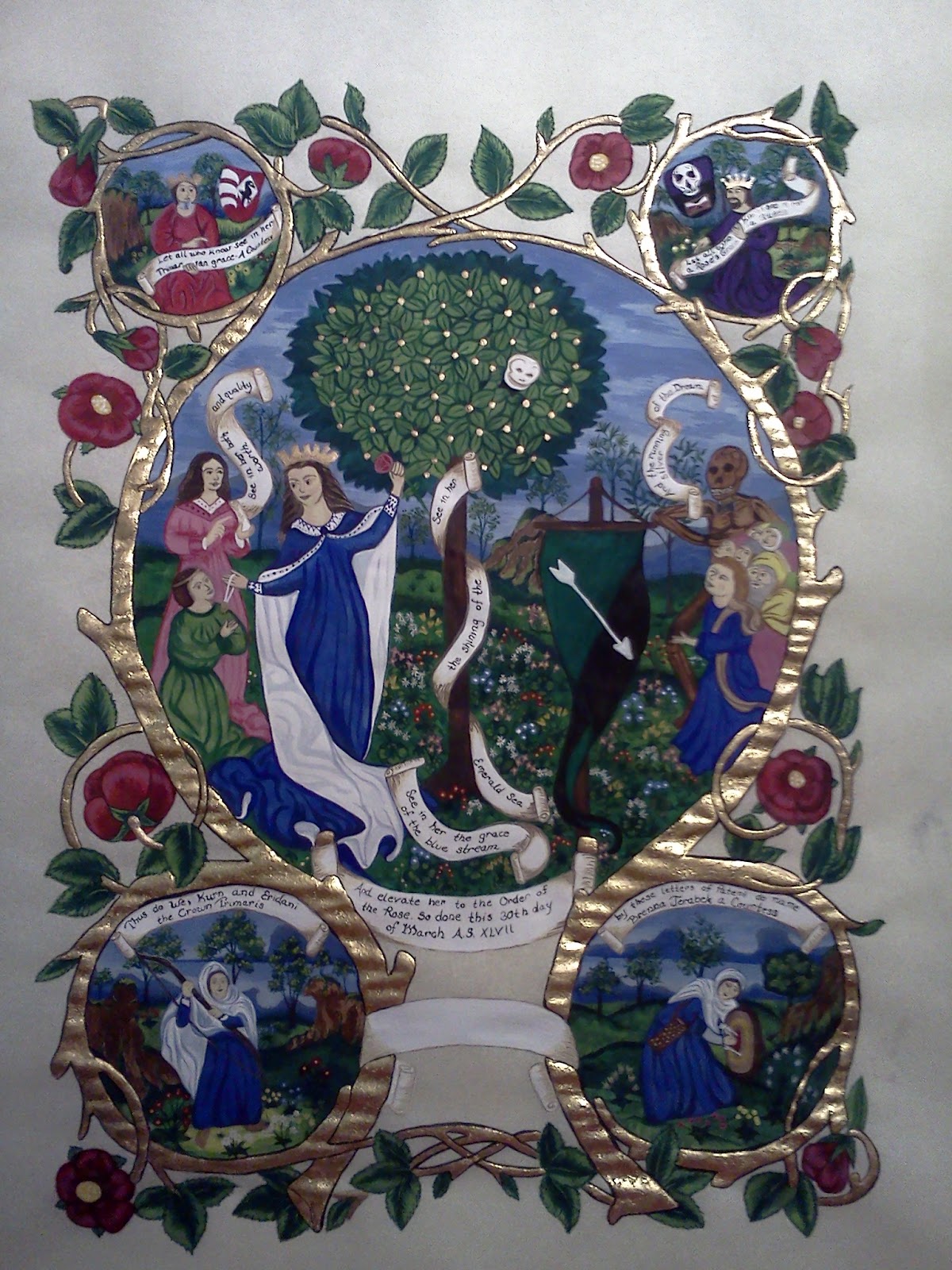
Brenna's County and Rose, layer by layer

Finished piece, day 7

Let all who know see in her Trimarian Grace - a Countess.
Let all who know see in her a Rose’s Grace - a Queen.
See in her both worth and quality.
See in her the shining Emerald Sea.
See in her the grace of the blue stream
and the running silver of the Dream.
Thus do we, Kurn and Eridani, Crown of Trimaris
by These Letters of Patent name Brenna Jerabek a Countess
and elevate you to the Order of the Rose.
So done this Mar. 30th  AS XLVII


Text composed by: Lord James Highgate


Illumination and Calligraphy by: Baroness Maol Mide ingen Medra, OL, OP

Illumination inspired by: The Salzburg Missal Folio 60 verso. Circa 1480 in Regensburg, Salzburg


Day 6, more details, some faces started

Day 5, details in top scenes, finish detailing border leaves and roses

Day 4 cont. More clouds and shading

Day 4, finish base colors, continue shading, flowers and clouds in bottom scenes

Day 3  More base, some shading

Day 2, Gilding and base colors

Day 1, Gesso nightmares
Not to self: don't do another page like this is seven days. It is a terrible idea. Your hand hurts. Your back aches.  You are no longer 21 and can work for days on minimal sleep. You have a full time job. Knock it off already. Love, Reality.

Sunday, February 24, 2013

Pantoum: Blossoms

Blossoms of orange scent the ink dark night,
Slip sweet as a lover through my window,
a languid kiss of spring and sugar.
Oh, how I have ached for this hour.

Slip, my sweet, as a lover through my window:
Your hands, your breath, your flesh
Oh, how I have ached for this hour.
My need, bare as a flower in the pale light.

Your hands, your breath, your flesh
I unfurl beneath each honeyed caress
My need, bare. A flower in the pale light
As blossoms of orange scent the ink dark night


Notes

So I noticed how long it has been since I have written any poetry and I was displeased with myself. I thought to take a line rattling in my head an use a poetic form to help me expand it. Pantoums are not especially easy so this might be not be the best route toward encouraging me to write again. What I love about pantoums is the repetition and the breathing of new meaning into the lines with each stanza.

I will probably work on this some more at another time as I am not entirely thrilled with this first foray back into poetic form.

Thursday, January 31, 2013

Gwenhwfar ver Cain, Pelican

j5
  • Award: Order of the Pelican for Gwenhwfar ver Cain
  • Inspiration: Dagulf Psalter circa 790 CE
  • Drawing: Mistress Finnedan inhen Ruadhain. OL
  • Illumination: Baroness Maol Mide ingen Medra, OL, OP
  • Calligraphy: HL Finnguala inghen Alisdair
  • Text: Baron Severin Visconti di Milano, KSCA and Baroness Maol Mide ingen Medra, OL, OP
Ok, so I dislike most early period illumination. I admit it. What I hate most is knot work. This is what knot work usually sounds like in my house: “Over, under, over, under, over, over, @%$!”. When my friends tell me they want an early period piece as a peerage scroll I mostly glower at them and ask if they are sure. Then I start chasing down designs that I do not loathe. This Pelican scroll was one of those times.
j3
Gwenhwfar is my best friend and I was very excited for her elevation and to work on her award scroll, until she told me that she wanted something early period. Then I just sighed and tried to make the best of it.

We settled on the Dagulf Psalter, known also as the Golden Psalter as the text is written mostly in gold. There are only a few decorated initial pages. This piece takes Gwenhwfar’s favorite elements from each and combines them into a single illumination. If you would like to see more images of this Psalter, check out this Pinterest board. I’ve been using Pinterest as a ‘look book’ for working with clients who want an illumination. It helps me show them what the options are and lets them pin images to the same board if they find something they like.

We pieced together a design from the various illuminations. The page was laid out and drawn by Mistress Finneadan and then illuminated and gilded by me. The background for the initial page was a bit of a challenge. Rather than trying to dye the pergamenata, I used several layers of waterproof India ink to provide the same look and on which we could still calligraph.

Finnguala executed the beautiful and challenging gilded calligraphy on the initial page and then the gold ink calligraphy on the right page while I pulled out all my museum prep skills and made a false book onto which the scroll could be placed inside a shadow box. The ‘book’ has a foam core cover that is covered in white kid leather that was a bit dry and not suitable for gloves or regular use. Several false pages were created using a fine paper. The book was secured to the velvet backing with pins and carefully placed foam core to hold the ‘cover’ at a slight angle to create more of an open book appearance. A single feather and a butterfly we mounted inside the case to help balance the look and add our household symbol- a butterfly. Lastly, I mounted in the award, added a strip of ribbon as a book mark,  and secured the corners of the pages with strips of cut pergamenata and pins so that the pages would not curl. The overall look worked pretty well giving the impression of a book.

j2The wording for this award is written in four quatrains called Englyns, short but remarkably difficult. This Welsh style of poetry has a  rhyme scheme and syllable count that is fairly unique, and thus, pretty challenging. What I learned while writing englyns is that you should always stock mixers for your rum or you can find yourself drinking rum and diet Dr. Pepper (which is a combination I don’t think I would recommend). In case anyone ever suggests that writing poetry is easy… well, it isn’t. Doubly so while on command, under a time crunch and when trying to write something beautiful and fitting about your best friend. Rum does help though.

The first line of the first englyn recalls Saint Barrwg: Saint Baruc (also known as Barruc or, in modern Welsh, Barrwg [ˈbarʊg]) was a 6th century Welsh saint. Baruc, who was a disciple of Saint Cadoc, forgot to bring the latter's reading matter with him on a journey from the island of Flat Holm. Cadoc sent him back and he drowned in the Bristol Channel on the return journey. He was buried on Barry Island. The ruins of the chapel that was dedicated to him can still be seen in Friars Road, Barry Island, Vale of Glamorgan. His feast day is on 27 September.
 
Barrwg forgot not her name – Gwenhwfar
Virtue and grace her fame
Service and she both the same
Her Honor a blazing flame


Ready hands, keen eye and quick quill – ladyj6
Possessor of such skill:
Problems solve, demands fulfill
Before asking lips are still


Striving, working all her days – Gwenhwfar
A kingdom sings in praise
With this peerage she is raised
Upon a Pelican, gaze!


At the closing of the year - post solstice
And for her we all cheer
Companions thus do steer
Liege Lords to make her peer.


In case anyone were to question the poetic style of this award as not adhering to standard SCA award style, a gloss text was added in deep blue on the burgundy initial page. If you look carefully, you can see this text written above the first line and between several of the uppermost lines of golden text:

Gwenhwyfar Ver Cain
Elevated to the Order of the Pelican
December 29, AS XLVII

Wednesday, December 12, 2012

Four painted pendants

This is what happens when I am left alone on a Friday night- I drink spiked eggnog and paint things that amuse me. Each pendant contains two mini paintings inside a metal frame with glass covers.

Kiwi! Apteryx and Actinidia, respectively.
Kiwi Actinidia
Kiwi! Apteryx
Kiwi Apteryx
Kiwi! Actinidia

Kites
Kites
Closer Still
Closer Still
Two Pair
Two Pair
Now available at Currant Thoughts

Monday, December 03, 2012

Lo, they do call me


The depiction of Yggdrasil was inspired by a carving from the Hylestad stave church door, circa 1175. The door depicts scenes from the story of Sigurd, in this scene Regin sleeps and Sigurd roasts the dragon's heart and burns his finger. The original carving places Sigurd and Regin at the base of a beautiful and smooth curving tree. The birds are original to the carving but the roots and the serpent Níðhöggr were added from my imagination. I chose to keep the illumination a subtle mix of browns which is both reminiscent of the carved wood of those ancient doors and appropriate for the gravity of the piece

The text for this page was inspired by the Risala of Ahmad Ibn Fadlan, a 10th century Islamic traveler who first-hand witnessed a Rus ship burial and wrote about what he saw. During that burial, a slave girl is sacrificed with her lord. Shortly before she is killed, she speaks this brave prayer which was translated to Ibn Fadlan as he watched the burial ceremony. This particular version of the prayer text is used in the movie The Thirteenth Warrior and is a poetic interpretation of the many translations of the Risala.

The pseudo-runic font I found on the title page of a 1908 printing of The Elder or Poetic Edda. To date, this is one of the better runic illusionary runic fonts I have found.

The text reads:
Lo there do I see my father
Lo there do I see my mother, my sisters and my brothers
Lo there do I see the line of my people, back to the beginning. Lo, they do call me, they bid me take my place among them, in the halls of Valhalla, where the brave may live forever.

Prints are now available at my Etsy store, Currant Thoughts.  
The prints measure 4.5 X 6.5 inches and are matted in brown to 8 X 10 inches.

Special thanks to my Asatru heathen friends Brad Taylor-Hicks and John Beale who consulted with me and helped to consider which version of the text would have the best, and most appropriate, appeal. Also, thanks to Hunter Masters, my resident source of Norse mythology and symbolism.

Monday, November 26, 2012

Don't Blink: Weeping Angel Illumination

Continuing in my series of illumination for geeks I picked what is, in my opinion, the creepiest villain the Doctor Who series has ever created.

Weeping Angels...

Prints are now available in my Etsy store Currant Thoughts just in time for holiday shopping... or scaring the crap out of your friends and family.

This was a bunch of fun to create. I especially enjoyed playing with the twining ribbon around the frame and the angel itself. As for the hand at the bottom, well, there is a few hours of my life I won't get back. Hands = no fun ever.

Last night I finished a Norse inspired piece so I hope to have that up in a few days.

Friday, November 02, 2012

Gõcauo Diego Ramiriç, Knight

alhambra

Within this Dream, upon the fields of the Known World, each of us has the opportunity to become something more, something better. Inside ourselves we find a nobility and grace that we did not know that we possessed and with each year we shape our rough clay smooth, revealing a bright light inside. Some men, like our good Gõcauo Ramiriç, shine so bright that they help to guide us all toward something greater.

In his words and deeds are found the prudence, fortitude, temperance and justice that marks him as a peer of the realm. He embodies a courage, a faith and a quality of mercy that reveals him as a true Knight of our Known World. As such and in consort with the Order, We, the Crown Trimaris, find it right and proper to elevate Gõcauo Ramiriç to the most noble Order of the Chivalry so that all may known him as a peer of the realm and society. On this day we charge you to stand exemplar of the ideals in which we believe and never to hesitate to give your life in the just defense of God, your lord or your Kingdom Trimaris.
So done by our hand upon this 27th day of October in the year or our society XLVII.
Krotuas, Ceaser & Brenna, Empress

Design and Execution:

Design for this illumination inspired by the Nasrid plaster carvings and Kufic inscriptions at the Alhambra palace of Grenada. 

Design and Layout: Mistress Maol and Mistress Finneadan
Illumination: Mistress Maol, Mistress Finneadan, HL Finnguala ingen Alisdair and HL Bronnach of Kildare
Calligraphy: HL Finnguala ingen Alisdair

Hours: Approximately 90ish

Notes: You know how every now and then I draw a line and say “I’m never doing this again”. Well, this is one of those times. Bringing light and depth to a monochromatic piece takes a lot of time and a lot of fiddling about with colors. Coaxing life and subtlety into this piece was a large chunk of the hours count. I’m really glad it is done and that Gõcauo likes it. However, I really no interest in seeing another image of plaster carving or of the Alhambra for quite some time.

Thursday, November 01, 2012

Lorcan’s County

IMG_2194
If I lead old friends into the fray,
I sing under the Shield,
And they fare into battle mighty and whole
and they fare from battle whole,
they are whole wherever they go.
------Havamal  verse 156.
All men praise nobility and worth. It is most praiseworthy of a King and Queen to recognize the accomplishments and value of their people. Therefore, We, Duncan and Larissa, King and Queen of Trimaris, do demand that all people honor the valiant and true Lorcann an Dubhghaille for this day He is proclaimed Earl. Let all the honors, rights, and privileges of this lofty rank be his due. For this day He has done the most noble and honorable of deeds.He has returned the fair Kingdom of Trimaris to Us richer and mightier than when He first received its Crown. Done by our hand this second of April, A.S. XLV
Duncan, King
Larissa, Queen
Design and Execution:
Design based upon the Ornside Bowl, an 8th century silver bowl crafted in York and found in the grave of a Viking warrior buried in Cumbria who likely looted the piece during a raid on York.
Shield Construction by Baron Segda ui Mordha

Drawn by Lady Brynna of Kildare


Text, Transliteration, Calligraphy and Illumination by Mistress Maol Mide ingen Medra

Painting assistance provided by HL Gwenhwfyr ber Cain, Lady Brynna of Kildare, HL Arianna Rosa Cristina de Veniziano, Mistress Theodora Perplexa, Lady Franca Donato and dozens more who assisted in small portions so they could lend their skills to this unique project.
      This piece was completed almost two years ago but I just recently received these close up photos of the work. Thanks to Patricia Bauman for the photos.